

Understanding
complexity.
Deep Technology & Intelligence
GNOMA is a deep technology and intelligence lab. We build systems that help people investigate complex questions, connect evidence, and understand what remains uncertain.
Black Week 2026 · Private preview
Chapter 01 / 09
GNOMA / Thesis
Complex problems rarely fail
because the information is missing.
01
Information is scattered. It sits in different institutions, formats, languages and centuries, and almost never in one place.
02
Records disagree. Two credible sources conflict, and the conflict is often the most informative thing in the file.
03
Relationships stay hidden across documents, institutions, people, geography and time, visible only once the fragments are held together.
04
Context falls away. Claims become separated from their origins, and a statement outlives the conditions that made it true.
05
Uncertainty gets reported as certainty. A summary reads as settled long before the evidence is.
We build systems that keep those conditions visible while you work, rather than resolving them away before you see them.
The objective is not more information. It is better understanding.
Chapter 02 / 09
GNOMA / Selected work
One intelligence architecture.
Different domains of complexity.
Three systems, each built for a different body of evidence, each running on the same family of reasoning mechanisms. All three are in active development.
How each system reasons
The lower path is where the system declines to conclude
01Sources
02Mechanisms applied
03Outcome
Swipe to see the whole diagram
Readings are assembled from witnesses rather than from a privileged text. Similarity between traditions is shown, never asserted as borrowing.
01Sources
02Mechanisms applied
03Outcome
Swipe to see the whole diagram
A verified fact stays separate from a stated intention, an observed outcome and an inference. Corrections are preserved beside the original rather than overwriting it.
01Sources
02Mechanisms applied
03Outcome
Swipe to see the whole diagram
A related person is not an authorized person, and retrieved evidence is not a confirmed case fact. Where a condition is unmet, the case says so.
Chapter 02 / 09 · System 01
01
Theological Intelligence
Texts · Language
History · Transmission
Read the text.
Trace the idea.
Investigate the claim.
In development. Not yet publicly available.
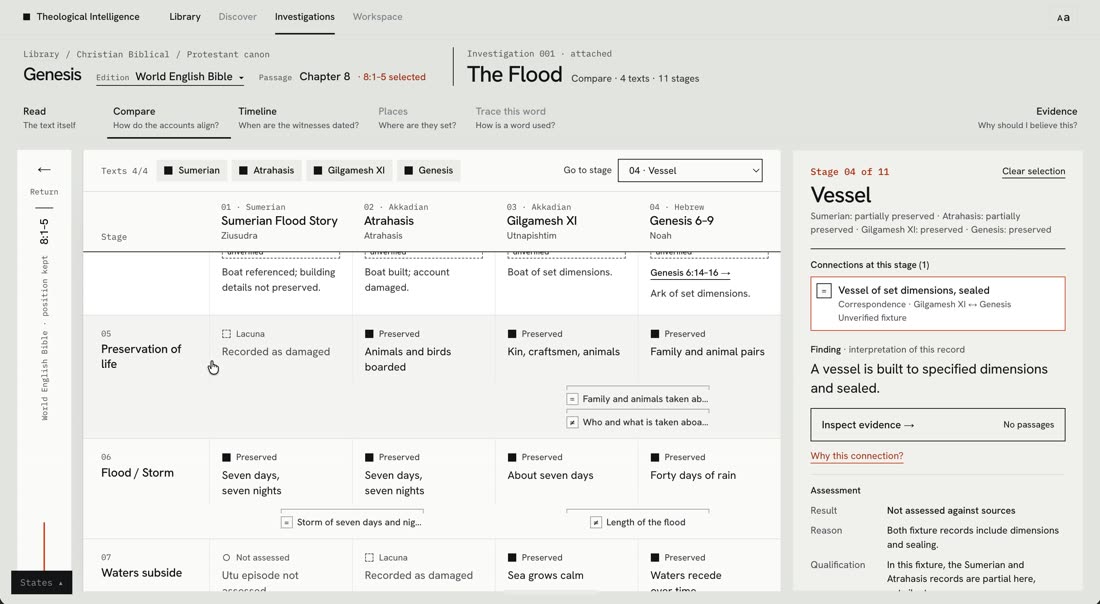
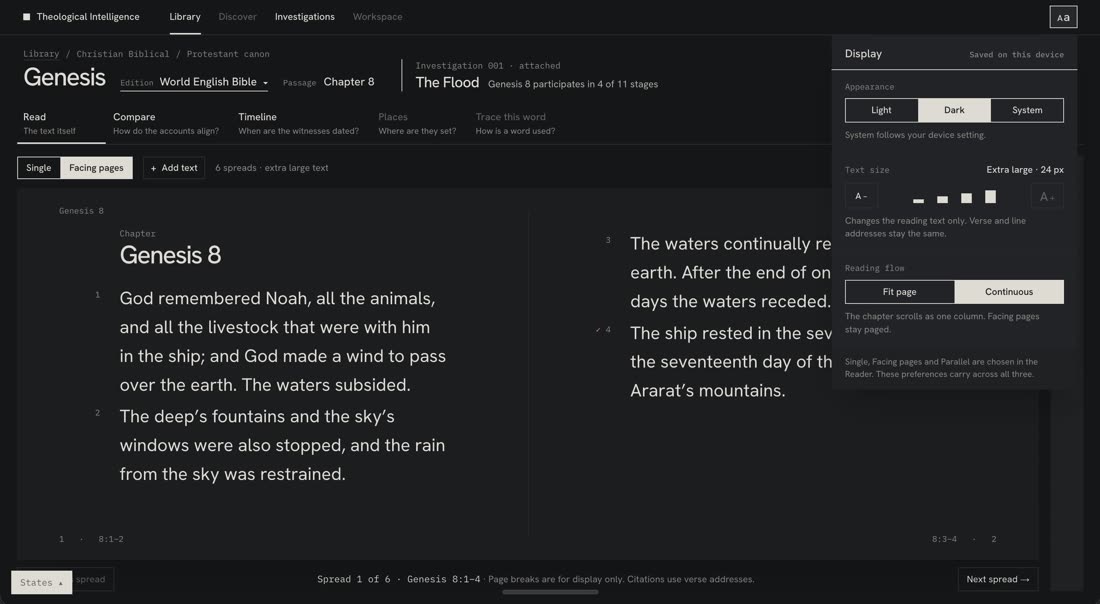
A research environment for exploring religion, ancient texts, language, history, and culture, where readers can compare sources and interpretations while pursuing questions on their own terms. No single tradition or school is treated as the reference point, and where readings differ the system keeps the difference visible and attached to its sources.
Case analysis · Benchmark 01
Fragmentation, witness alignment and reconstruction under changing scholarship.
Example investigation
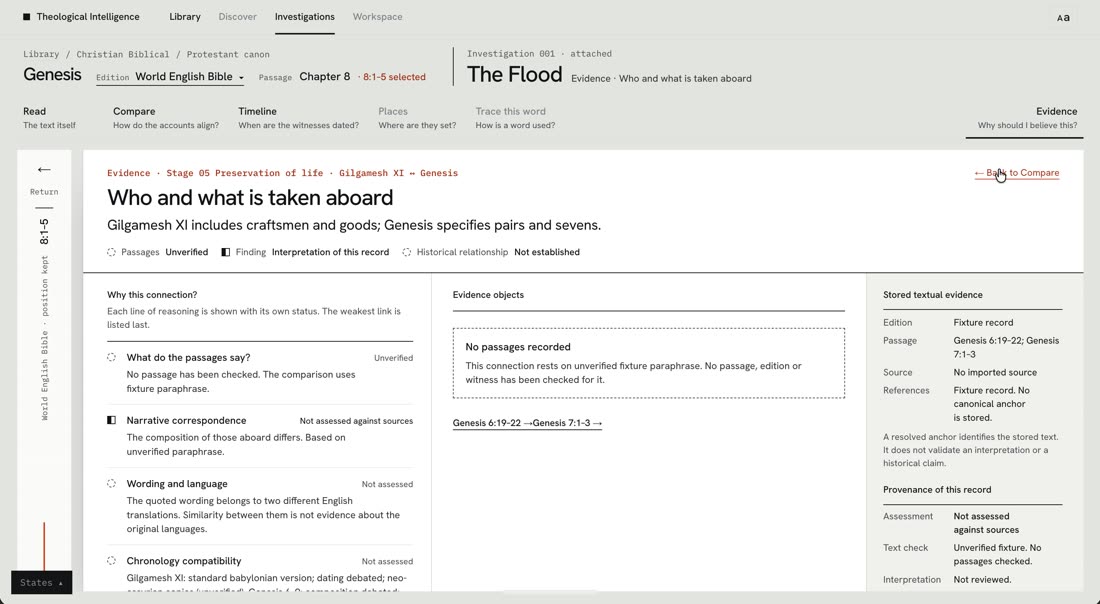
Follow the Flood account across the Sumerian tradition, Atrahasis, Gilgamesh XI, and Genesis 6 to 9, stage by stage, and see at each step what survives, what is damaged, and what has not been assessed.
Evidence
Surviving witness
Anchor
Addressable region
Align
Witness level
Lacuna
Modelled absence
Attribute
Who claimed, when
Qualify
Support and dispute
What the system declined to conclude
No text is the privileged reference point. Similarity does not establish borrowing or common origin. The figures in this benchmark are development evidence, not certification.
Chapter 02 / 09 · System 02
02
Civic Intelligence
Institutions · Records
Decisions · Public systems
Public information exists.
Understanding what happened is harder.
Research and architecture stage.
Begin with a public project, institution, place, or claim, then follow the records to investigate what happened, with every step linked to its source. The system separates a verified fact from a stated intention, an observed outcome, and an inference, and where the record is silent it reports the silence rather than filling it in.
Film arriving for Black Week
Geographic entry
Records and organizations
Evidence relationships
Case analysis · Charleston laboratory
A public project retrospective,
carried through to community impact.
Example investigation
Reconstruct the Charleston Technology Center from its own paper trail, then carry it through to community impact, keeping every claim attached to the record it came from.
Claim
As stated in record
Evidence
Source and provenance
Assessment
Evidence state
What the system declined to conclude
It does not infer criminality, and does not convert correlation into causation. Archived material is treated as historical reference rather than authority. Corrections and audit history are preserved rather than overwritten.
Chapter 02 / 09 · System 03
03
Legacy Intelligence
VASIS, pronounced Va sis
Families · Cases · Records
One case. A connected record of care.
In development. Lineage and property work is research.
VASIS is being developed to bring people, documents, service planning, and decisions into one continuing case, supporting the work of care and the records families carry forward.
A case holds what it asserts, the conditions each assertion requires, and the evidence behind them. Where a condition is unmet, the case says so instead of estimating around it.
Film arriving for Black Week
Case workspace
Participants and documents
Readiness
Case analysis · Live source conflict
Two authoritative state sources disagree about a filing deadline. The case reports the disagreement.
Direction of work
Reconstructing a family lineage from incomplete records while preserving provenance and uncertainty. Heirs property, property history and eligibility are adjacent research directions, not features available today.
Source A
Act 128 of 2026, revised trigger, eff. 15 May 2026
Source B
State code page and agency FAQ, prior language
Authority
Both official
Temporal
Effective date and version
Contradiction
Held as contested
Output
Conflict exposed
What the system declined to conclude
It does not decide which source wins. A prior case is context, not authority. A related person is not an authorized person. Retrieved evidence is not a confirmed case fact.
Chapter 03 / 09
AMON
Pronounced A mon
Mechanism family
Different domains. A shared approach to understanding.
AMON is GNOMA's evolving family of reasoning mechanisms, being developed to trace sources, connect evidence, examine change, and preserve uncertainty across different domains. Each domain has its own rules, authorities, and context, and these shared mechanisms are what carry across them.
What we are building toward
- 01Trace a claim to its source.
- 02Understand what changed over time.
- 03Surface disagreement between records.
- 04Identify missing evidence.
- 05Keep consequential decisions subject to human review.
Conceptual sequence
Simplified. Not the full architecture.
01
Evidence
02
Entities
03
Relationships
04
Claims
05
Assessment
06
Uncertainty
07
Inference
08
Human review
Mechanism vocabulary
Working language. Implementation varies by system.
Resolve
Decide when two records describe the same thing, and when they only appear to.
Trace
Follow a word, a claim, or a narrative through sources and through time.
Corroborate
Weigh independent support, and separate repetition from confirmation.
Temporal
Order events, and hold what was knowable at each point in the sequence.
Provenance
Keep every assertion attached to where it came from.
Contradiction
Preserve conflict rather than resolving it prematurely.
Gap
Name what is absent, and what the absence would mean.
Adversarial
Argue against the current reading before accepting it.
Assess
State confidence, and the conditions that would change it.
How mechanisms combine in one investigation
A civic reconstruction might run Resolve to settle which organizations are the same across filings, Trace to follow a decision through the record, Temporal to order what was knowable when, Corroborate to test whether two documents are independent, Gap to name what is missing, and Assess to state how far the reading can be supported.
A textual investigation runs a different set. Provenance and Contradiction do most of the work, because the question is less about what happened than about what each witness attests and where the witnesses diverge.
We do not claim every domain reasons identically. The mechanisms are shared. The rules, authorities and context are not.
Chapter 04 / 09
GNOMA / Common layer
These applications are different.
The underlying problems are not.
01 / Theological Intelligence
Texts · Beliefs · Language · History
02 / Civic Intelligence
Institutions · Records · Decisions · Public systems
03 / Legacy Intelligence
Families · Cases · Records · Assets · Obligations
Common structure
GNOMA develops reusable reasoning mechanisms that move between domains rather than rebuilding intelligence from scratch for every problem.
Each domain has its own rules. Shared mechanisms help connect evidence, trace change, and surface disagreement.
Chapter 05 / 09
GNOMA / Position
Stated at the level of
capability, not companies
Our focus is how systems reason with evidence.
Most of the surrounding technology is already solved, and we treat it as commodity. Our effort goes to the layer above it. The sorting below is an internal engineering position, reviewed continuously.
Buy or borrow
07
Treated as commoditized
- Foundation multimodal models
- Document and handwriting recognition
- Embeddings and retrieval
- Basic knowledge graphs
- Generic entity extraction
- Geocoding and demographic data
- Graph infrastructure
Build
09
Where the work goes
- Evidence and relationship models
- Provenance graph
- Temporal semantics
- Entity and relationship resolution
- Contradiction handling
- Uncertainty representation
- Alternative explanations
- Human review and confirmation
- Evaluation harness
Not yet
07
Declined on present evidence
- A new foundation model
- A universal cultural risk score
- An automated conspiracy detector
- An autonomous causal claim engine
- A population opinion estimator built from social posts
- A national rule engine
- Automatic legal conclusions
Principles guiding our research
- Resemblance is not equivalence.
- Correlation is not causation.
- Reaction is not proof of intent.
- Attention is not population opinion.
- Repetition is not coordination.
- An official source is not automatically authoritative.
- Absence of evidence is not evidence of absence.
- Inference should remain identifiable as inference.
- Consensus is evidence about reception, not a substitute for the evidence.
The differentiation is a hypothesis under test, not a finding. Where an existing category already covers the ground, our research says so and moves up a layer.
Chapter 06 / 09
GNOMA / Areas of exploration
Exploratory
Not shipped products
Where this work can lead.
Fields where the same reasoning could extend.
These are directions of inquiry, not products under development.
Cultural intelligence
Visual analysis · Symbol analysis · Semiotics · Narrative transmission · Historical context · Cultural response
How does a symbol's meaning change across communities and time?
Investigation
Complex research · Due diligence · Evidence synthesis · Open source intelligence · Institutional analysis
Which records support a claim, and where does the evidence break?
Language and text
Translation · Comparative texts · Computational philology · Etymology · Claim genealogy · Narrative evolution
How has a word or narrative changed across translations?
Civic systems
Public records · Institutions · Funding · Policy history · Property · Infrastructure · Accountability
How do public decisions connect to projects and community outcomes?
Legacy and property
Family records · Lineage · Heirs · Property history · Assets · Eligibility · Documentation
How can fragmented family records support a more connected history?
Legal intelligence
Cases · Precedent · Claims · Evidence · Arguments · Cross case relationships
Which precedents actually bear on the case in front of you?
Education and research
Source comparison · Research environments · Argument construction · Historical context · Evidence literacy
How do you teach someone to weigh a source rather than accept it?
Spatial intelligence
Geography · Movement · Spatial relationships · Physical environments · Spatial reasoning
What does the arrangement of places tell you that a list of them cannot?
A principle we carry across all of them: separate resemblance, influence, interpretation, and intent rather than collapsing them into one conclusion.
GNOMA Lab / Research note
Cultural Intelligence
Open question
Benchmark specified
Can a machine distinguish visual resemblance from historical influence, cultural interpretation, and intentional reference?
An open question, studied as a problem where a single classification would be the wrong answer. Each layer is assessed separately, and the disagreement between layers is kept.
01
Image
02
Symbol
03
Reference
04
History
05
Time
06
Culture
07
Reaction
08
Intent
09
Uncertainty

Study image · Third party photography used as research material. Not a system output.
Matched controls pair contested artifacts with visually similar uncontested ones, to prevent the system learning that historical imagery means controversy.
Chapter 07 / 09
GNOMA / Lab
Research posture
As of 1 October 2026
The systems are products.
The mechanisms are the research.
GNOMA Lab develops and tests reusable reasoning mechanisms. The research examines how systems connect evidence, preserve disagreement, and recognize when a conclusion remains unsupported.
Every investigation becomes an opportunity to improve the underlying reasoning system.
Research snapshot
Internal registry · 1 October 2026 · Not customer results
Validation targets registered
311
Production validated
0
Discovery domains inventoried
100
Domains under test
03
Research gates defined
07
Controlled experiments specified
05
None of the registered targets is production validated. We publish the registry as it stands because a validation count is only meaningful if it can also read zero.
Research streams
Note 001
Evidence and provenance
100 domains inventoried
Note 002
Temporal reasoning
Source conflict recorded
Note 003
Contradiction preservation
Variance tested on paper
Note 004
Trace
Benchmark 01 active
Note 005
Case reasoning
4 of 5 packets closed
Note 006
Cultural interpretation
Benchmark specified
Research status and methodology
The snapshot above comes from GNOMA's internal mechanism validation registry as recorded on 1 October 2026. It describes the scope of work registered and reviewed inside the lab. It is not a set of customer results, production metrics, or externally audited findings.
Mechanism validation is separate from product maturity. A system can be in development while the mechanisms underneath it remain research. Where internal suites have been run, they tested architecture against modelled cases on paper. They did not test deployed products with customers.
One limitation we state plainly: no primary field research has been conducted in the legacy domain. No interviews, no observed workflows, no live cases. Every efficiency claim in that program is currently an argument, not a measurement.
Chapter 08 / 09
GNOMA / People
In stealth
Network across the US and Canada
Founder-led.
Built through a network.
Carlos Whiteside
Founder, GNOMA
A product and experience design leader with more than fifteen years across enterprise platforms, fintech ecosystems, digital products, emerging technology, and complex experience systems.
At GNOMA the work runs well past design. He directs the company's product vision, experience architecture, research direction, system development, and the translation of ideas into working intelligence products.
The three systems in this preview were originated and directed from that position: the thesis behind them, the experience architecture, the research programs, and the prototypes.
Distributed senior network
GNOMA brings experienced practitioners around each problem when deeper domain expertise is required. The network currently spans the United States and Canada.
-
Engineering
Full stack product development.
-
Technology and AI
Senior technical guidance on architecture and applied intelligence.
-
Product and experience design
Interface, interaction and system design alongside the founder.
-
Healthcare and enterprise
Domain and operating perspective from inside regulated organizations.
-
Program leadership
Complex delivery and organizational execution.
-
Agency and delivery operations
Production capacity and process when a system moves toward build.
GNOMA remains in stealth. Several collaborators hold senior positions elsewhere, so we do not publish names.
Founder-led does not mean founder alone. The centre stays small on purpose. The expertise assembles around each intelligence system, and disperses when the work is done.

Bring us a problem
worth understanding.
Deep Technology & Intelligence
Tell us what you're trying to understand. We're interested in research collaborations, product partnerships, and complex problems worth investigating.